
Stress Isn’t the Problem
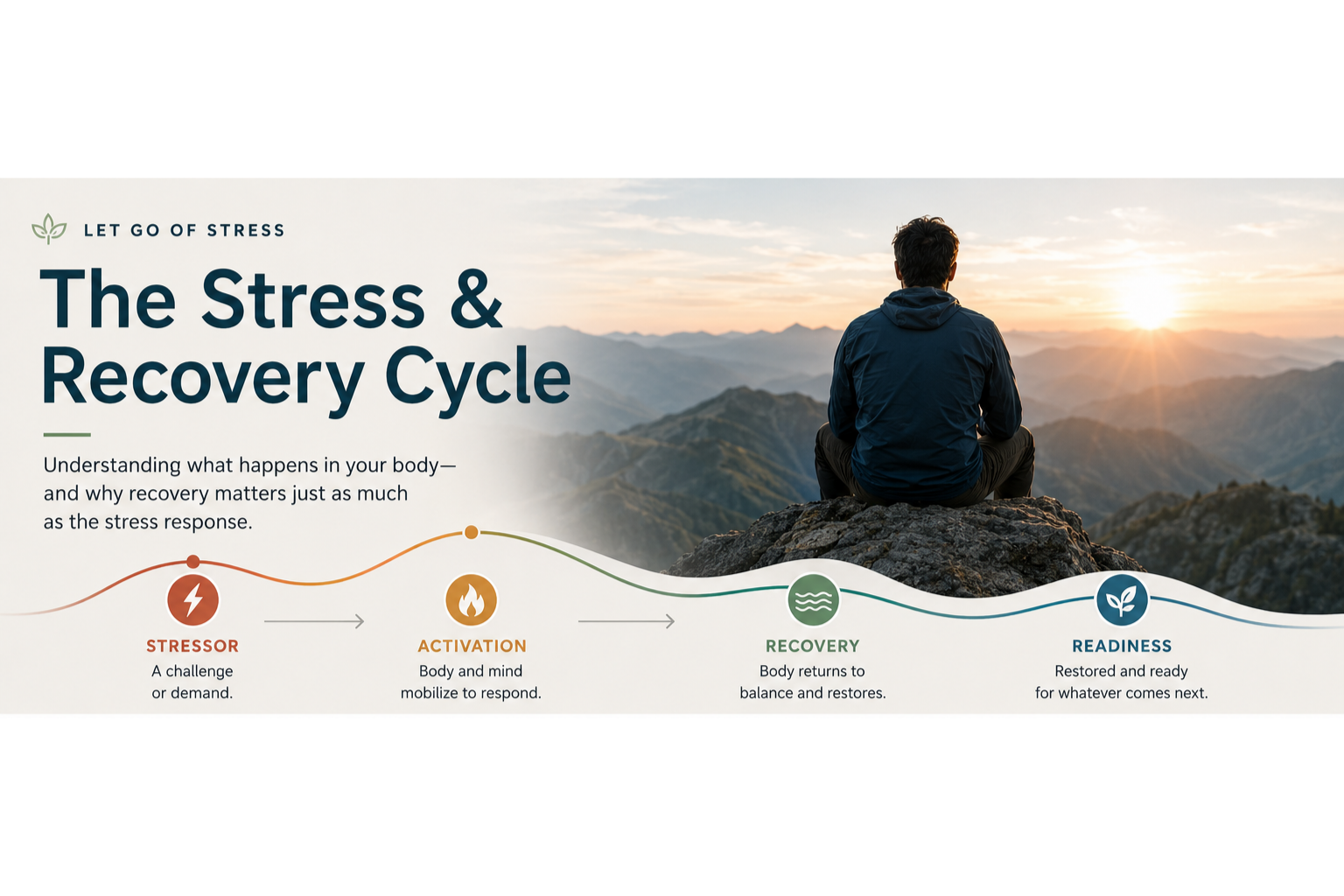
Understanding the Stress & Recovery Cycle
What happens inside your body when you're stressed—and why recovery matters just as much as the stress response itself.
I've been thinking a lot lately about something most of us probably know intuitively, but may not fully appreciate:
Our bodies aren't designed to never experience stress.
They're designed to respond to stress— AND recover from it.
That distinction has been opening up an entirely new way for me to think about stress, my nervous system, the way I have conditioned myself, and even what it means to take proper care of myself.
Your Stress Response Is Trying to Help You
Stress gets a bad reputation, but the stress response itself isn't necessarily the problem. Not to get too nerdy, but let’s break this down.
When your brain and body perceive a challenge or threat, multiple systems begin coordinating a response.
The sympathetic nervous system (fight/flight) helps mobilize you quickly. Heart rate and blood pressure can increase, breathing changes, and energy becomes more readily available so you can respond to what's happening.
Another system—the hypothalamic-pituitary-adrenal, or HPA, axis—helps sustain the response through hormones such as cortisol (our body’s primary ‘stress hormone’).
Our bodies do this automatically and in an instant. All this is part of an incredibly sophisticated system that helps us adapt, respond, and survive.
This process of adjusting our physiology to meet changing demands is sometimes described as allostasis—maintaining stability through change.
But Activation Is Only Part of the Story
Here's the part I've become fascinated with:
What happens after the stressor is over?
Our bodies also have processes that help us move away from mobilization and toward recovery.
Parasympathetic (‘rest and digest’) activity—including influence from the vagus nerve—plays an important role in regulating the heart and supporting this recovery process.
I recently came across a 2025 research paper* that focuses on measuring the time it took for the heart to return back to a parasympathetic state (‘homeostasis’) following acute psychological stress. The researchers refer to this as cardiac vagal recovery.
I find the concept of measuring the heart rate variability interesting as it is directly influenced by the nervous system and stressors that are perceived.
We spend so much time talking about what happens when we're stressed.
But what about our ability to recover from being stressed?
When “Keep Going” Becomes the Pattern
This is where the research started feeling very personal to me.
For much of my life, I became really good at pushing through.
Keep going.
Solve the next problem.
Think about the next thing.
Get through the day.
And even when my body wasn't physically doing something, my mind would continously doom-scroll through the collection of “worries” and “what am I not thinking about that I need to be thinking about?”. OMG it was exhausting!
The body is remarkably adaptive. It continually adjusts to what we're asking of it.
But repeated or prolonged demands on our stress-response systems can come with a physiological cost.
Researchers use the term allostatic load to describe the cumulative physiological burden associated with repeated adaptation across multiple systems of the body.
That doesn't mean stress automatically causes illness, nor does it mean every difficult experience is harmful.
It means that recovery matters too.
What Does Recovery Actually Look Like?
Recovery doesn't necessarily mean lying perfectly still or somehow forcing ourselves to “be parasympathetic.”
Our nervous systems are much more dynamic than that.
Recovery might look like:
sleep
a walk outside
laughing with someone you love
taking a few slow breaths
stretching
eating and digesting a nourishing meal
sitting quietly for a few minutes
moving your body
loving on my fur babies (doggies)
practicing TRE®
or simply recognizing that, in this moment, nothing is requiring you to fight, flee, solve, anticipate, or perform.
What supports recovery may also be different from person to person.
The important part, for me, is beginning to recognize that rest and recovery aren't something we earn after we've finished everything else. They're part of the cycle our bodies need to thrive.
Learning to Hear My Body Again
Something unexpected has been happening as I've created more space for recovery in my own life.
I'm hearing my body more clearly.
Sometimes her messages are remarkably simple:
Drink some water.
Stretch.
Slow down.
Take a breath.
Look at the sunrise.
I don't think those messages suddenly appeared.
I think I'm becoming quiet enough to notice them.
The more I practice TRE® and explore my own nervous system, the more I'm realizing that my relationship with my body doesn't have to be one where I continually ask her to keep up with me.
I can listen too.
That is beginning to change what self-care—and ultimately self-love—actually feels like to me.
It's Safe to Feel Safe
For those of us who have spent a lot of time stressed, anxious, vigilant, busy, or simply “on,” slowing down can sometimes feel surprisingly unfamiliar and downright scary.
I've experienced that myself - and from time to time I still do, as I’m unwinding myself from the stress-ball I find myself in.
There have even been moments when I've noticed myself becoming uncomfortable because I wasn't stressed. As if being stressed was a “safety” feature I had adapted.
That's where a phrase I've started using with my own body came from:
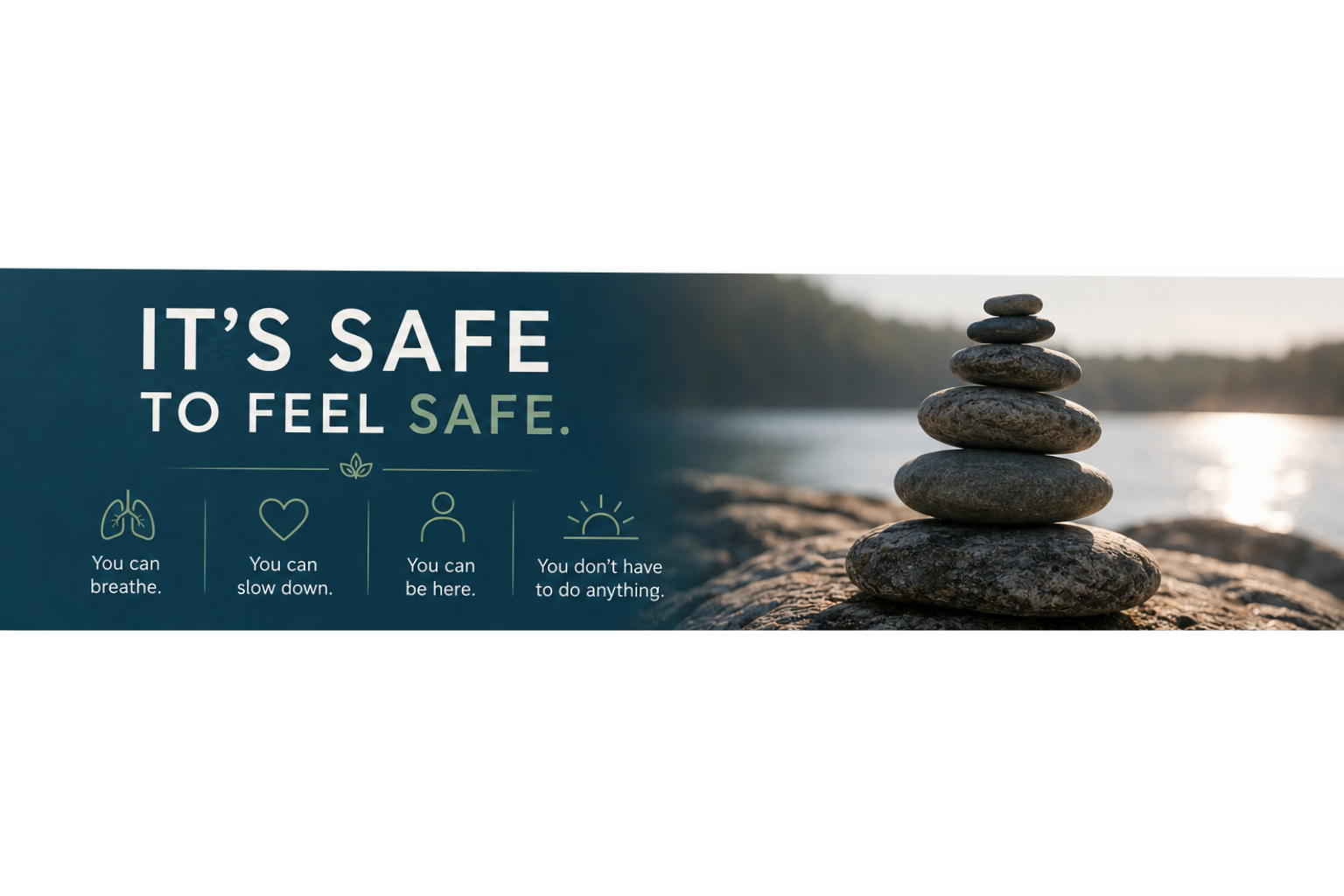
“It's safe to feel safe.”
I'm not using it to force myself to relax.
It's more of a reminder that I give myself from time to time when I notice anxiety start to creep in.
“Right now, you don't have to do anything.
You don't have to solve anything.
You don't have to anticipate what's coming next.
You can simply be here now and know that you are safe to simply be.”
Something to Explore
Instead of asking yourself, “How do I get rid of stress?”, try becoming curious about a different question:
“What helps my body recover after stress?”
Notice what happens after a demanding conversation, a busy day, exercise, travel, worry, excitement, or anything else that activates you.
How easily do you settle?
What does settling feel like in your body?
What helps?
What gets in the way?
You don't necessarily need another thing to do. You may simply be learning how to notice your body's signals again.
And perhaps, little by little, reminding yourself: “It's safe to feel safe.”
Want to Explore the Research?
*Here is the 2025 research paper that inspired this exploration. The researchers examined 294 studies involving more than 23,000 adults and looked at how vagally mediated heart-rate variability (vmHRV) changes during recovery from acute stress.
Cardiac Vagal Recovery Following Acute Psychological Stress in Human Adults: A Scoping Review
Neuroscience & Biobehavioral Reviews, 2025